Choose timezone
Your profile timezone:
After a brief introduction to ultralight dark matter (UDM), we will review the current status of experimental searches for these candidates. In particular, we will explain why modern precision clocks provide powerful probes of UDM. We will discuss existing and newly proposed well-motivated models of UDM and argue that they share a common feature: their dominant coupling is often to the QCD and nuclear sectors.
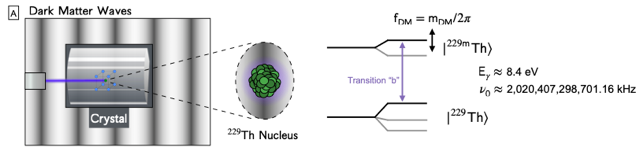
This is especially timely, as we are currently witnessing a revolution in the field. Recently, laser excitation of the Th-229 nuclear transition with an effective precision of 10^(−13) has been achieved. As we will show, these advances are already probing previously unexplored regions of parameter space. Moreover, a Th-based nuclear clock could potentially improve the sensitivity to dark matter and other new physics by up to ten orders of magnitude. We will also qualify to what extent such enhancement estimates can be trusted, and demonstrate the dramatic implications for fundamental physics leading to thorium supremacy.
A picture is also enclosed, taken from our recent paper, https://arxiv.org/pdf/2602.16804
Prof. Dr. Tobias Hurth